

As all my text this one is also long form. If you are not ready to read it to the end, you are probably not for business. I am writing from experience, I never came to write after being inspired by a book, podcast, some call or something like that.
This article will be valuable for you if:
-
- Feel tired of posts like how to make 46.000 dollars in 30 days.
-
- Want to start own story
-
- Are already in the game and feel stuck
-
- Want to keep forward and get out of it
-
- Want to earn money ( on a hard way and accept it)
Illusion of work – The goal is to work not to look like you are working.

Iman Gadzi – icon in modern marketing – one of the world’s favorite business gurus.
I remember myself doing everything Iman said five years ago. I was reading a book a week, and sometimes I failed that target. I woke up at 6:30 a.m., took cold baths, ran, and went to the gym every single day.
I benefited from all that – all those books totally changed my mindset. But here’s the thing: I never really listened to him. I was more fascinated by how he lived, walked, where he lived, and his “aesthetic” lifestyle.
I watched his and Sander Stages’ videos like “How to Learn FB Ads in 2020” and “How to Start a Profitable Business in Less Than 30 Days.” I wrote down everything they said – and nothing was immediately valuable. I only got it two years later.
I lost two years TRYING TO LIVE LIKE THEM. I had lied to myself subconsciously.
These guys live to sell their stories – that’s what we call “influence marketing.” There’s really nothing valuable in it… unless you’re on their level and want to make a film about your life. They probably spend a month curating invitations, stories, and trips around the world, waiting for the perfect sunlight to take good pictures.
You will never learn anything from them that actually makes you more money. I see them as one step in a mindset journey. Iman was the first person on the internet I watched. Out there on Instagram, there are a zillion copy-paste people trying to do the same thing.
For this type of success, a lot of things have to fall into place.
Hooks for poor people – Why do we keep falling for the same biz BS every year?
As you can see, all these videos have one thing in common – the year in the headline.
The explanation behind this is simple: people love instant success. They think some magical shortcut will appear this year, and they won’t have to work anymore for the rest of their life.
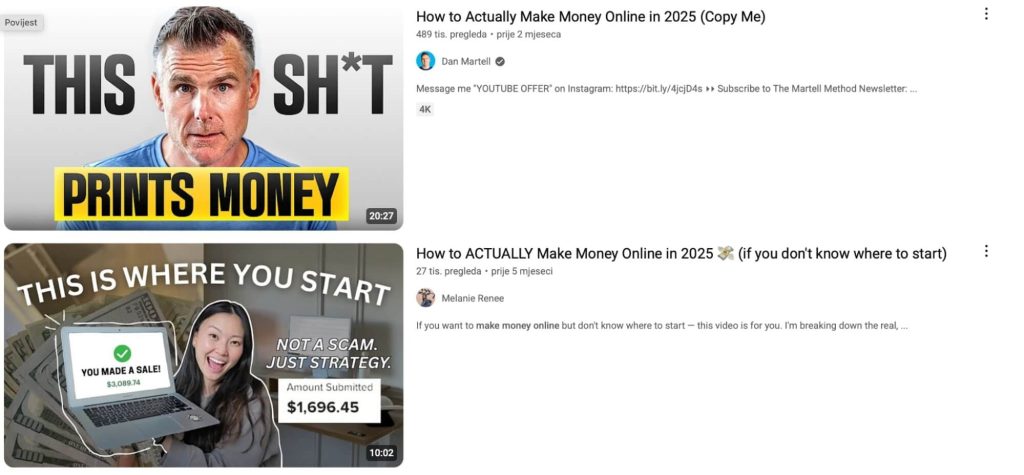
This logic doesn’t make sense. If making money last year guaranteed success this year, everyone would be rich by now.
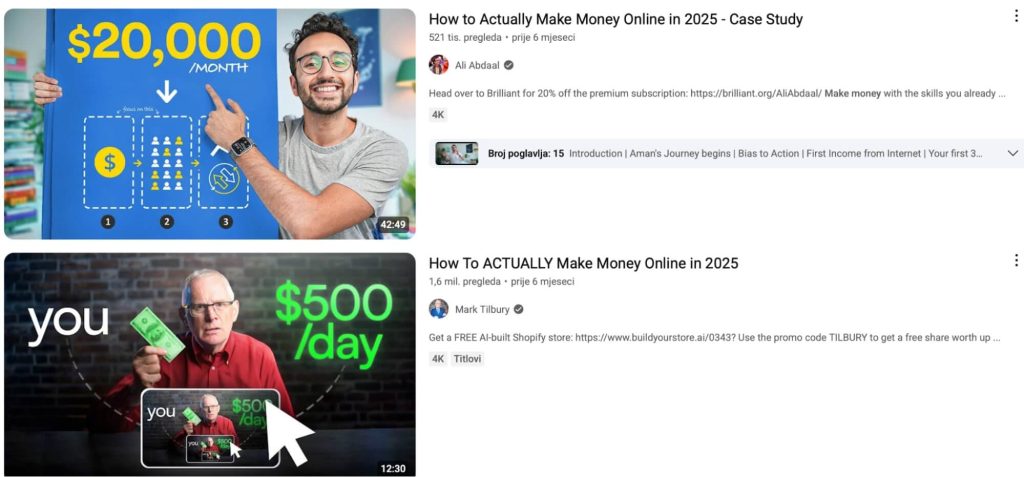
These creators hook you with weak, flashy headlines, and as a beginner, you’re the perfect audience for them. Here’s the fun fact: these videos get tons of views, which is ultimate proof of human psychology at work.
It would be fine if these were new viewers, but they’re not. Believe it or not, the same people watch these videos year after year. They never face themselves honestly and can’t accept the fact that there’s nothing magical about starting a business.
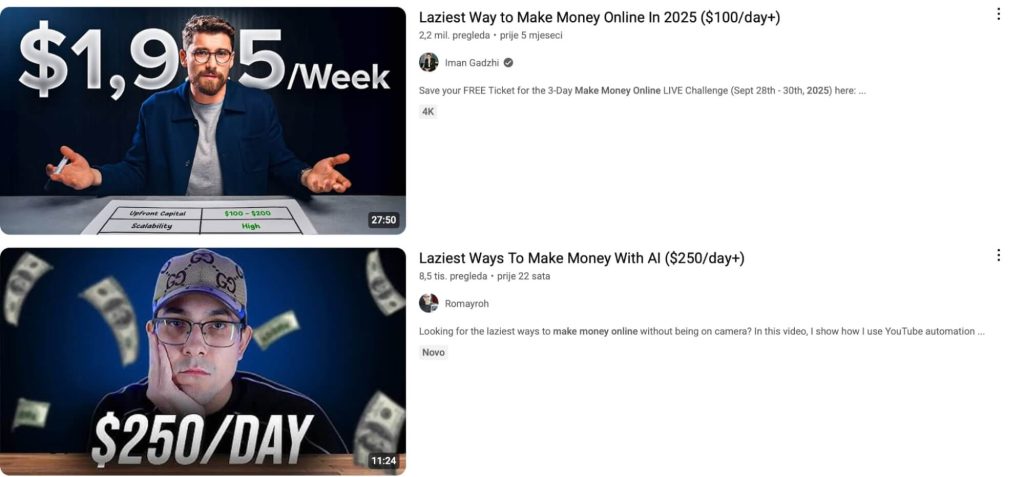
These creators also know their content works because amateurs don’t know how to recognize real value. To beginners, these posts look extremely logical and valuable, but here’s the kicker: if you dig a little deeper, you’ll notice the same patterns repeated over the last five years.
And beginners? They always latch onto one word: Money.
Because that’s the pain point they all share.
Making Money Isn’t Magical
Reading self-development books and watching podcasts is useful… for some people.
If you’re even a little bit intelligent, you’ll quickly realize: reading a book or watching successful people won’t make you money.
This is exactly where I got stuck. The root of it? Comfort feel.
I never went out — no partying, no drinking, no sleeping in. I felt good about myself because I thought I was “on the right path.” But the truth? I wasn’t doing anything. I was just waiting. Waiting for excuses that were always lurking around the corner.
You stay at home, reading, watching, listening to people’s stories. You feel productive, but in reality, you’re not. You’re not out there driving your own bike, making your own moves.
In the moment of waiting, you burn. You think you’re moving forward, but you’re standing still.
Let me give you a real story. My very good friend’s dad — he’s been my neighbor my whole life — barely finished 8 years of primary school. He’s 50 now.
Back when I was a kid, he already had money, driving a new Mercedes in his 20s. I always wondered: what’s his secret?
The point is: no worries, you can always make a lot of money. There’s nothing special about it. Don’t listen to anyone who tells you, “AI system that makes you €100k per month,” because it won’t. You’ll just lose.
*****Full list of beginner books I’ve read? I shared it in my group — join for free. ( Check home page )
Starting over and over and over again – Solution!
From the very beginning, six years ago, my wish was simple: to have something I could actually work on. A business where everything is under control, and the only thing I had to do was work.
Every summer I’d start something new — looking for jobs, mentors, opportunities. I never focused on one thing; my only goal was to learn as much as possible, because I heard it on a podcast. My knowledge was scattered, too broad.
When someone from another agency pitched me and asked, “So, what are you specialized in? What can you actually do?” – I had no answer, to be brutally honest.
I even messaged 300 VaynerMedia employees trying to work with them. I know the exact number because I made a sheet of all of them. Haha.
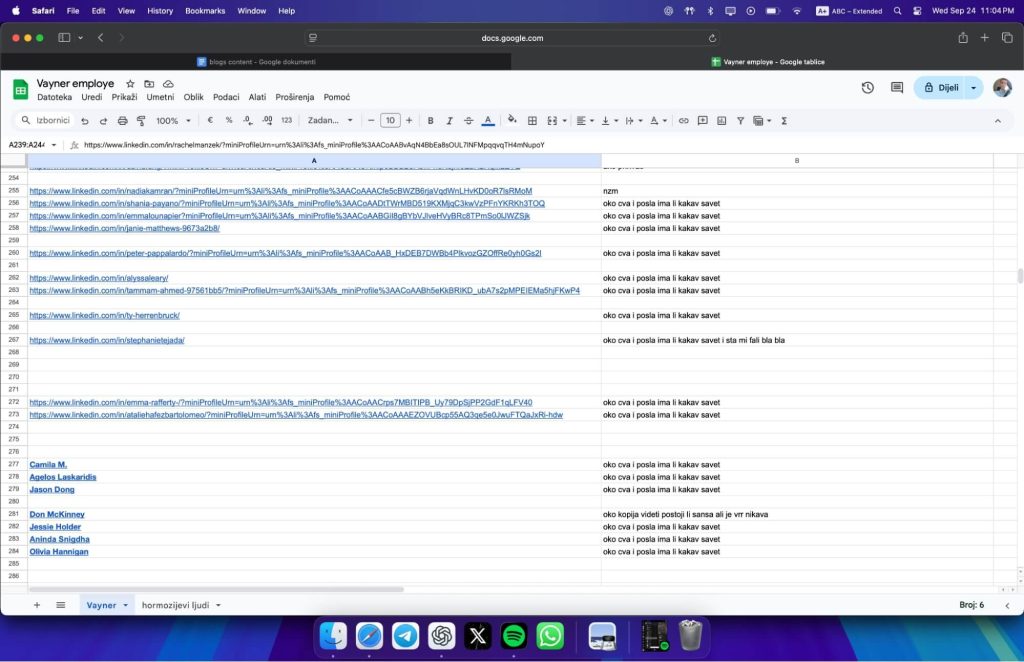
Fun fact: One of them actually accepted me, and I ended up writing for Google, NatureMade, and random brands I had never seen before in my life.
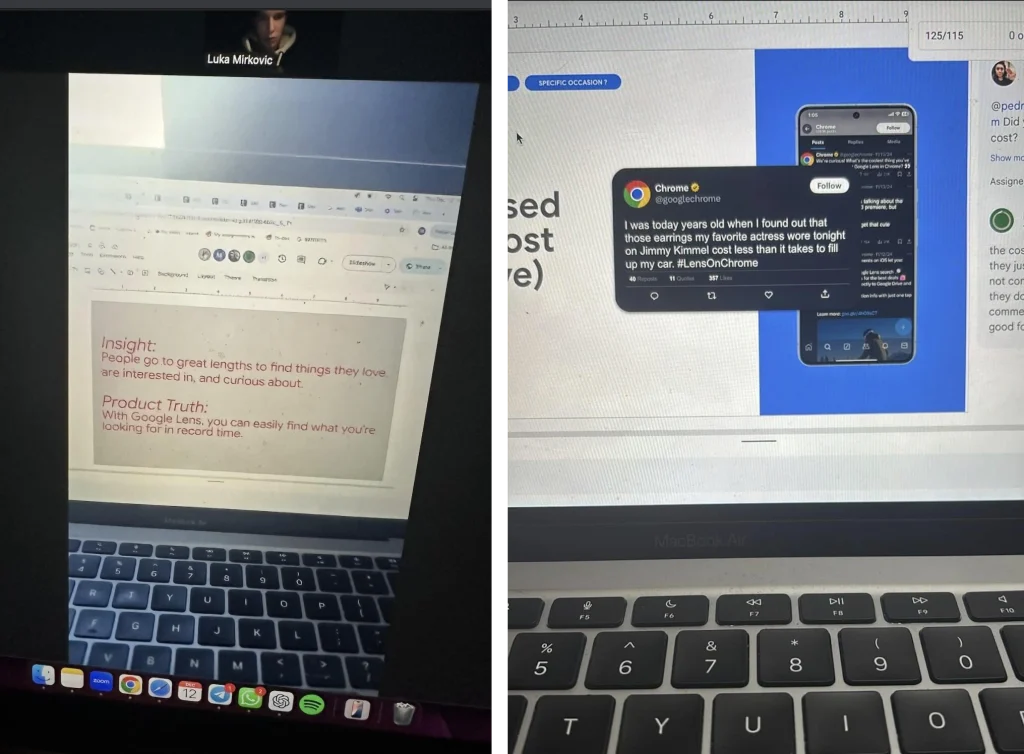
( (Me in the car in 2023, 12 a.m. in the left photo. They worked in New York, a totally different time zone mine is 6+ hours ahead.)
How do you find purpose in one thing?
The truth is – you probably won’t always work on what you truly love. You just have to pick your goals. Mine aren’t just about money. I have friends who have real millions but can’t form simple expanded sentences, and have no sense of behavior or influence on other people. I loved them for their traits, but I never wanted to change who they are.
Accept that on your path, you’ll work on things you like more and less. If your only goal is money, you will never find purpose in what you do.
Here’s a practical exercise: take a blank blue sheet of paper (not a note or mobile app) and write down what you really want:
-
- Freedom
-
- Maybe 5 employees without big management
-
- A company where I can get government tenders
-
- A sexy secretary
-
- Work with people as they are
etc…
This will bring you closer to your real goals. If you focus only on money at the start, it won’t work well. You can make enough to buy a Ferrari by selling eggs at a local market or by selling online courses.
In my case, starting over and over again led to some serious burnouts. But I gained skills that allowed me to work with several different industries worldwide and deeply understand human behavior and psychology.
Some of the people I followed are now making 10X more money than me — even though I have more knowledge than they do.
What did your brain eat this morning?

There are phases we all go through in this game.
You probably follow the same influencers I did. You’re blinded by their money, perfect lifestyles, advice, bodies, marathons after making 30 million dollars, and similar stuff.
When you follow too many of them, you’ll end up tired — motivated at night, but demotivated and sad in the morning.
After one or two falls, you’ll feel completely exhausted.
If you keep following everyone’s advice and listening to every opinion, remember: opinions are like… well, everyone has one, but rarely is it 10/10.

REAL DETOX HACKS.
-
- Follow only 1 or 2 people max in your entire industry on every social platform you use.
-
- Block all ads about your business.
-
- Follow whatever you like to watch that has nothing to do with your business.
-
- Every 6–12 months, unblock them and see what’s new.
-
- Don’t read more than 3 self-development books per year.
-
- Delete social media for a few days – probably just 3 days, not 40.
-
- Enjoy memes, silly TikTok/Instagram comedy, hobbies – stuff you genuinely like.
Don’t let them manipulate you with their “hacks” or make you think you have to think their way.
The big lie about self-development.
At 16 and 17, I was reading almost a book a week. I was fanatical about it – but not because it was actually helpful. I didn’t learn anything useful. Mostly, it was my excuse to my parents for not studying for school tests.
Don’t fall into that trap of reading a ton of books.
Do you have to read them?
Yes.
Will you make more money from it?
No.
Reading a book will give you a better approach and wider thinking – just like traveling around the world. People who are not fixed in one place tend to be more open-minded. Indirectly, your vocabulary improves, and you’ll learn faster because when you sit down to study something new, a lot of it will already feel familiar.
How to use a book to get the best ROI?
Have you ever heard of someone learning to ride a bike or perform a C-sect from a book?
The same goes for starting a business. There’s no book that can teach you everything. Even if you see “Read this for sales, this for marketing, that for mindset,” you’ll only hear stuff – you won’t feel it. Business is about feeling.
After 5–10 books on business, stop reading. Take a break for 1–2 years. At that time, just work. Slowly, you’ll start noticing patterns:
-
- How people react when you tell them the price of your service
-
- What happens if you offer a discount
-
- What happens if you get rejected
Once you start seeing visible progress, go back to reading. ( Making money with you paid bills)
What books should you read?
Everything except business. Novels will give you better ideas for copywriting than any book about copywriting.
OK, 6am is it? And am I awake ? What should I do?

How to Survive Entrepreneurship: How Long Can You Really Last?
One of the things that kept me feeling behind was all the talk about “routines, productivity, daily goals,” and similar stuff.
In the beginning, everyone is in the mood of “work hard.” Now, when you don’t have a family, you can take risks. You can be awake at 2 a.m. if you want – but my question is: what can you actually do?
You might keep it up for a maximum of 7 days; on the 8th, you’ll again be like, “What’s going on? I have no idea what to do.”
Also, many of us can’t work every day, all day. I can, but only if I know exactly what I’m working on. That’s the hardest part – you don’t even know where to focus.
If you want to start any business, you’ll have questions like:
-
- Do I need a video editor?
-
- Should I learn editing for myself or?
-
- Is it better to pay someone?
-
- Where do I find an editor?
-
- If I spend 10 hours learning, when do I do everything else?
-
- How do I get answers for technical stuff, like setting up checkout on a website?
-
- Can I hire someone for web dev?
Following all these questions leads to negative feelings:
-
- “I’m not good at copywriting, is ChatGPT enough to start?”
-
- “People will figure out I have no idea how to deliver this level I promised.”
-
- “What if prospects use terms I don’t understand?”
-
- “I’m broke, he had initial capital, I don’t.”
-
- “I know what to do today, but I don’t know how…”
There are really two paths in this situation – I’ve been through both, unfortunately.
-
- HELL PATH
-
- MENTORS
HELL PATH
Learn from your own mistakes and go through thorns alone.
This path requires a sick desire to get up every single day until you set up a foundation that really makes money and pays bills.
If you don’t, you will end up with ideas of $100M or just keep being poor (as I was). You won’t have anyone to share your thoughts or ideas with, and it’s easy to have fights with family and friends.
You have to BE CAPACITY for this – to have enough strength to keep it all inside you. Your head will feel like it’s about to explode.
Your feedback will be your wallet. You have to do everything alone and think about every detail. Mostly, when you ask for help, no one will give you the amount of help you need. You will get 100 pieces of advice from random people – some will be useful, some won’t work for your case, and some will just push you back to square one.
You will feel like a beginner no matter what you are doing. Even if you close 10 deals, you’ll lose your mind realizing you don’t know anything, even after 2 years of learning.
All of those macro and micro falls will give you feedback on what you’re good at, what you love, what you need to work on more, what requires connections, what skills matter, where to spend money, and what to do yourself.
The cost of this path is unpredictable – but if you stay long enough and accumulate real experience, you might become a “new Elon Musk” (at least in my mind :)) haha.
You have to learn time management. Lack of responsibility gives you free time you’ll waste figuring out the right directions.
I’ve been living this life for almost 3 years and I’ve developed traits and habits that give me the ability and capacity to never give up, do everything, accept hard things, and LEARN.
Once you gain a lot of experience, “people with money” won’t work with you just because you show up. They won’t care about your car or your Rolex.
I’ve been judged like:
-
- “You are talking about it, but where are your results?”
-
- “Look at N.N. (has pics of a Ferrari). He doesn’t require half of what you’ve said and makes more money.”
-
- “If you know everything you’re talking about, why aren’t you making money then?”
All of this stuff will kill you. You have to keep at it until you make something.
You will lose a lot of friends. In my case, I didn’t lose them, but I started seeing them differently. Try to forgive what people say – they probably lack knowledge, life experience, and are still living in Disneyland.
After you make your first euro, people will talk about how they believed in you, and try to claim everything that made you lucky – or how their path was harder than yours.
This is totally normal. The crucial point is to move forward without burning bridges.
I did it. It made me nervous – I thought all millionaires and billionaires were only LEGIT, fully grown, smart people.I made it special in my head and underrated others.
I still think some are special in their way, but they are no more or less special than you or me.
Maybe you’re smarter, more resourceful, more skilled in your field – but at the end of the day, we are all human. That doesn’t mean you’re a better person.
Skills + Experience + These Traits and Habits = Growth Person
*****For everyone going through this period, I suggest the group I created especially to connect with other real businessmen. Check home page
MENTORS
Working for someone who teach you everything
Working for someone who teaches you everything
This is 1,000 times better than starting a business blindly. Jobs with a salary give you breathing room and breaks, save you time and energy, and don’t crush your desire to start your own journey.
Here’s what I advise: work for someone for 3–5 years, as much as you can, to gain all the skills you’ll need for your own business.
How to find a good mentor?
Reframe the question: how do you find a good company?
The people who appear on your feed all have teams behind them. Everyone wants to work for Alex Hormozi, Gary Vee, Tomasz Gonnet, Iman Gadzi. But very few realize these influencers have intelligent teams working for them. Find 10–20 people closest to them. I had calls with Gary Vee’s second-hand team.
Reach out to them all. Don’t aim only for the top of the top. Millions of hungry kids spam them every single day. Remember – you’re not the only one.
In big firms, as all gurus’ companies are, you rarely get to swim in the deep end. They work at a serious level with seniors. Their name might help you later to build a brand, but that alone isn’t enough. You need proof: pictures of meetings, real experience, company culture, etc.
If you work in a smaller, lesser-known company, you’ll float more easily. You’ll get:
-
- Fast feedback
-
- Deeper connections
-
- In-person exposure
-
- Opportunities to work for free (which often leads to paid offers or full-time positions)
-
- Faster career growth
-
- Friends and networks
-
- Real work ethic lessons
The worst part? I worked for free for almost 2 years and 8 months.
Consequences of working for free:
-
- You’ll burn out
-
- You’ll feel behind because you can’t earn alongside
-
- You might continue offering things for free
-
- You’ll feel dumber than you actually are
-
- You may think something is wrong with you
How to avoid this, learn from my mistakes: after 6 months, ask for an internship or low-level role, for example:
-
- Checking grammar
-
- Editing 2 videos per day (just captions)
-
- Writing 5 scripts per day for clients
-
- Posting, following, growth-hacking profiles for clients
Accept any salary – even if it makes you feel like shit.
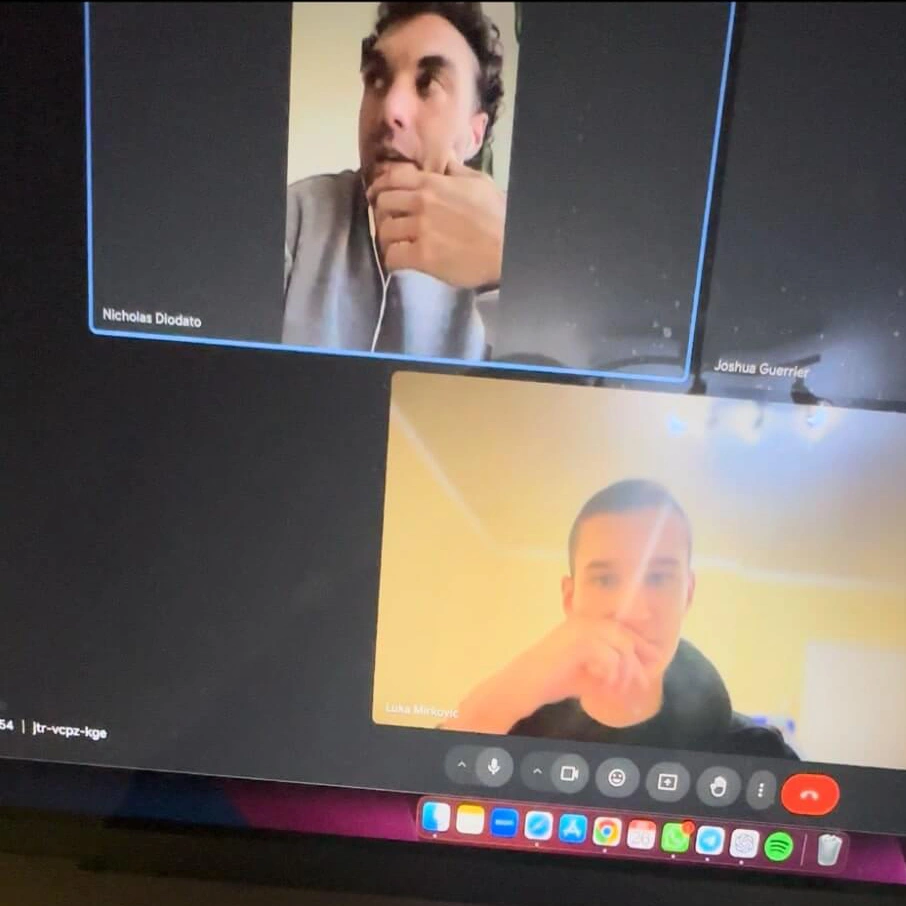
(For context: my description of this person would be the first 100 on the planet in marketing/braning/sales….)
I thought about these technical skills, you use Google Sheets, some copywriting, because I had the opportunity to write for specific clients, not just random stuff.
I got feedback on everything. You accept all tasks, and feedback pushes you forward. I got “lucky” that he was a strict, no-nonsense mentor who helped me grow, take responsibility for mistakes, and keep moving straight.
Their goals will be shared with you, and you can visualize how a firm should operate.
You’ll learn how to talk more professionally, how to answer things you don’t like doing, etc. There’s a lot of injustice in every company. Sometimes toxic conversations and relationships.
Don’t think that higher-paying jobs are perfect; at the base level, it’s all the same.
As I said, we are all human, but it’s dramatically better when your environment is educated rather than filled with “drain-brainers.”
They will also keep all important information about the company closed: revenue, goals, client relationships, hacks on how they get clients, scaling strategies, etc.
If you’re very smart, stay inside for a long period and infiltrate the root of the company.
How to do it?
Build strong connections with crucial people:
For a small company:
-
- Head of Operations
-
- Development
-
- Project Manager
For a big company:
-
- First 10 people closest to the owner
-
- VP, Core Relationships
-
- CMO
If you’re working remotely — research them on LinkedIn.
As I mentioned earlier, I did this when I was trying to work at Vayner Media.
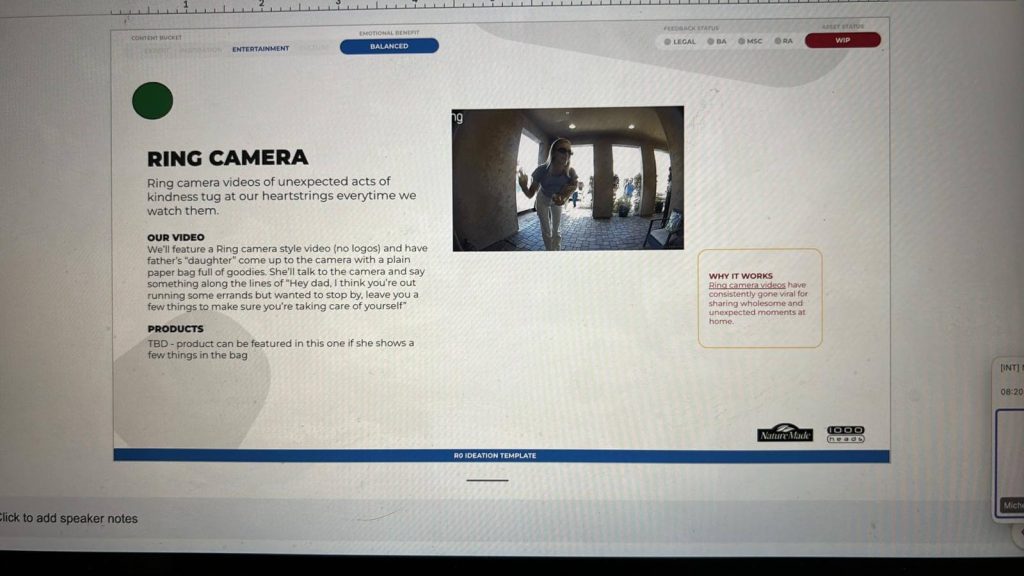
One guy, Matt, accepted to teach me copywriting. He’s on the next level of writing – directly writing for Google, TikTok, Vayner, creating full campaigns for Burger King and Sony.
So thanks to him. Believe it or not, it was very fun, but I actually made most of my progress with a completely random American girl who taught me English.
I didn’t translate anything. I’m from Serbia. I highlight this for a reason – any company I wanted to work for FREE rejected me, because they couldn’t pay me, time zones, not properly written resumes, etc.

(Nikola Jokic mindset G)
Serbian pure stubbornness turns me on. He came to the US and explained some stuff…
TIP: Try to make as many connections as you can, and always ask for additional help or explanations. Collect all the notes and apply them to your system.
Start here – you have my back! No worries – breathe in, make a cup of coffee, and take action!
I know exactly what’s on your mind.

You might imagine business or having a job like the ones you see online, but trust me – it’s not like that. The posts you’ve seen are just propaganda, scams by people trying to sell you fast money.
You see Lambos, fasting influencers, Rolexes, Bali trips with private jets… but most of that doesn’t exist.
Reality is the opposite. You’ll spend long hours locked in your room, working as much as you can every day. The learning process is boring, and yes, real business is boring too.
So what should you do with my experience? This is for anyone who feels stuck, constantly starting over, or falling behind.
STEP BY STEP – How to start.
Don’t quit your job too early
Do not quit your job if you want to start a business. That happens for 0.000001% of people, maybe it works for them, but for the average person, it doesn’t.
The perception of business for most people looks like this: you have a logo, nice design, you are the boss who tells others what to do, you have a budget for a coffee machine in your fancy office in New York on the 10th floor.
While you have a regular job, you can learn in parallel, make a budget, save money, and have a real insight into how much you need and what it costs to run a business.
In this step, you will see if you really want it. The most difficult time in business is the beginning.
How will you focus after a job? You will be tired, lack sleep, experience exhaustion, sometimes lose motivation, and people will start to hate you, and you them.
If you break down all of this stuff, you can start your journey and that’s the sign that you are ready.
How to find money for business?
Try to save 10/20/30/40% of your salary for business while you work. You will be ready when you have savings to cover living expenses for the next 6 months without a job.
How to find the time after a job?
Start prioritizing your time — sacrifice your social life, temporarily break up with your partner if needed, don’t go out for coffee, don’t go to the gym, don’t spend minutes of your life on anything that is not the dream you are fighting for.
For the first 3 months — set up one goal: to work. The goal is to work.
How to keep it?
Small steps, small wins — name your brand, design your logo, write the first pages in a private Google document, plan how your brand will look in the future.
Where to find motivation?
If you need something to push you every time it gets hard — give up. Find a reason in yourself that never would stop.
It’s normal to feel exhausted and doubt yourself — that doesn’t mean you’re failing, it means you are in the first, hardest stage.
Avoid the “guru trap”
A mistake, as some gurus advise, is to “just pick something.” But you can’t just pick anything. If you want to do something, teaching other people and building trust is the only way.
How to build trust and authority?
You need at least some knowledge when you speak. Just because you love going to the gym doesn’t mean you are automatically a fitness trainer.
You can try — as I did 5 years ago — but the result may be being stuck for a year, broke, and hating everyone who earns money.
I remember watching Iman Gadzhi at that time. It was fascinating to see where he went and how much money he made. I wanted that too, but I had no shortcut — I had to build knowledge, test, and earn trust step by step.
That’s why you need to avoid the hype and shortcuts that most beginners chase. These things might look appealing, but they don’t work in reality:
-
- Promises like “make $10k a month in 30 days”
-
- “Learn Facebook Ads in 10 minutes”
-
- Dropshipping tactics that supposedly make $20k in 7 days, or ecommerce hacks that promise $90k
-
- Millions of productivity or self-development hacks, like “read a book a week”
-
- Claims like “Only this model will work in 2030”
Instead of chasing these shortcuts, focus on learning your niche, helping others, and building trust. That is the only sustainable path to real results.
Niche – how to decide the right direction?
Now when you are aware of it, what can you do to position yourself first in your dreams?
Start to grab and run for as much as you can – learn and study everything about your niche.
If you want to be in the fitness world, go and work in the gym, follow the first 100 people in the industry,
look at what they are doing online, and ask them for deeper explanations. If that doesn’t work properly, find a trainer in your city who has a track record and work for free in exchange for answers.
This is adaptable and applicable for every market.
Network strategically – start connecting with people in your niche: collaborators, influencers, and potential clients. Focus on adding value before asking for anything in return.
(I only work with Coaches, Experts, and Entrepreneurs, skill-based coaches. Feel free to ask me for new concepts & ideas on how to reach experts in your market.)
Problems and solutions of the market – Meet them all!
All of these pre-steps will give you a clear picture of what you actually want besides money.
So now, you know exactly what to do, you need to figure out your ideal buyer persona or ideal customer.
Again, advice like “find pain points or problems and try to solve them” fails – because in the beginning you don’t know anything about your audience even if you think that you know.
When I was working with a big company (4 years ago) which had $500m/year revenue in the Balkans, they needed 20 years of working with people to know what they exactly want, appreciate, how much their services cost and how much they’re worth (two totally different terms).
They know how long it takes for a customer to come back again in a day.
That was a new level of business I saw at the time.
Start collecting small pieces of data now. Talk to 5 – 10 potential customers. Ask them what they struggle with. Observe patterns. Document everything. The sooner you understand your audience, the faster you can build offers that actually sell.
Use market smartly
Now you have what your competition does not have — a market advantage!
You’ve been working or have enough knowledge to build authority. You don’t have to waste time figuring out topics that will hit your audience.
Instead of spending 300 hours per week thinking about what to record today, you already know 100 pain points that will target them immediately.
Example of someone who jumped into the market without experience:
“This is the website that will help you learn Webflow! Click below and I’ll send you more information about it!”
Example of someone who worked in an agency and had 1000 briefs per month:
“On the Zoom webinar, I’ll teach you how to set up a cheap hosting domain and how to find free templates to start with!”
Here’s something important you’ll realize at this stage: The first thing you wrote down on paper — like a prototype of an offer — will likely not work, because in reality, people don’t want that.
You might be stuck with an offer like “lose 20 kilograms in 6 weeks.”
But 99.9% of them will pay much more for something practical, like videos showing what to buy in the market without even going there, using a ready-made shopping list.
Time for creating an offer
Once you start posting content – educate people and lead them to their dreams.
They will start commenting, liking (or disliking), asking questions, and you will get a “Market Feedback Loop.”
By the time, you will become better and better.
Now according to their inputs you can create your first offer.
Some people go too early into launching a product/service.
You have to create something that proves what you’ve been talking about on social media.
With zero social proof and testimonials everything what you said is questionable.
One ultimate hack to build trust and sell more — be honest.
“You are my first customer and I will give my best!”
HOW STUFF WORTH AND HOW TO CHARGE THEM FOR? ( real story)
After you’ve worked with your first couple of clients, you’ll gain confidence to move forward.
Collect as many types of testimonials as possible – video, text, comment, letter, opinion – and post them on every social media (later you can use them for ads).
If they’re not willing, give bonuses, discounts, or one month free.
At this step, start thinking about marketing. The biggest problem for almost every business is LEADS.
LEAD = POTENTIAL CUSTOMER.
To get them consistently, increase volume.
In my case, I sent cold DMs and emails to people I knew and didn’t know.
6 years ago, I messaged everyone from all cycling groups about an upcoming downhill race. I started 6 months before the race, sent RAW videos of jumps, rocks, and trails… Half of them showed up and paid a $30 entry fee.
We built downhill trails for 9 months. Organized food, transport, safety, Red Bull, referees… the event lasted 2 days and cost less than $30 per person. This opened doors to work with incredible people and learn what drives early success.
Be totally honest with prospects – don’t try to “sell,” try to help, make it fun, and build relationships. Charge less than it’s worth at first; they’ll come back to buy again. For every new 10 clients, charge a bit more. Always give additional bonuses to your first clients – they’ll support you and help grow your business.
They have to see goodwill and slowly grow to trust you. This is a process; it takes time.
1…2…3…Start!
Believe it or not – you are now already on the market. You exist, and people know about you. That’s a BIG WIN!
You don’t need fancy design, ultra-expensive colorful videos, you don’t need to run YouTube ads or Google ads.
You laid a solid foundation for future growth.
In my opinion, you need to find yourself in business. Probably 90% of us don’t even have a perception of how this will end up.
That’s what branding and positioning are for me – finding what we love to do, our wishes, our reflection in the brand.
Congratulations to yourself.
Quick 3-month plan:
Focus on experience & knowledge → create content → get feedback → create offers → collect testimonials → call me for the next steps
Keep in mind: 90% of people fail here. Why? They either stop too early, ignore feedback, or overcomplicate things. Focus on doing the right things consistently.
Join in the group
First 250 members join for FREE. ( 251 – $97/month.) Check Here.
Next steps:
DM me anytime if you need help, guidance, or ideas. I have full guidance ready and can add you to the list if you want more personalized support.
Also, share and post in your groups – at least 100,000 people worldwide are experiencing the same problems as you.
By sharing, you might help someone else who’s stuck, and at the same time, get feedback and new insights for yourself. Engagement in groups will also connect you with others who face similar challenges, creating a support network that accelerates learning.
Remember: this process takes time, and there will be obstacles. But everything can move faster if you follow the steps smartly, adjust based on feedback, and stay active in communities. Use the group to ask questions, share wins, or post struggles – you’ll get quick solutions, instant support, and practical advice.
Keep me updated on your progress – show me what you’re doing, and I’ll give feedback. The more you engage, the faster you grow. Sharing and helping others also adds value to your network and positions you as someone who contributes, not just consumes.
Key mindset: Patience + consistency > trying to do everything at once. This is your foundation – invest the time now, use your network, leverage communities, and it will pay off later.
